
Navigating Absence or Estrangement During CNY Reunion

Feb 16
4 min read
Updated: Feb 18
Reunion dinner is the centrepiece of Chinese New Year (CNY) and it's not just a casual suggestion, but the entire cultural expectation wrapped up in one meal. CNY carries a particular kind of weight because everything hinges on one concept: 团圆 (tuányuán), i.e. reunion, with the full table, multiple generations, everyone accounted for, everyone home.
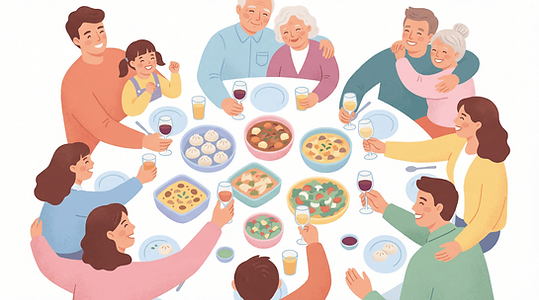
Why absence hits differently during CNY
Perhaps someone isn't there because they passed on, or perhaps the relationship couldn't survive what happened between you, or even perhaps you chose distance to protect yourself and they're alive and well somewhere, just not in your life anymore. Maybe it is complicated in ways that don't really fit into neat explanations when relatives ask "where's your family?" Maybe you are finding that you don't fit in with family dynamics and it feels weird to be present during CNY.
The entire cultural machinery of CNY is designed around gathering, which means when someone's not there - whether death, estrangement or choice - that gap becomes impossible to ignore. We can't exactly skip past the 'reunion' part of the reunion dinner.

The pressure to be past it
What makes this harder is the sense that you should have sorted this out already. People expect you to either still be hurting or to have gotten past it, like those are the only two options. But at the same time, you can miss someone and know the distance you put between both of you is necessary, and you can grieve but also feel lighter without them in your life.
Sometimes these feelings don't cancel each other out, they just exist alongside each other, often in ways that feel messy and contradictory.
When grief, estrangement, and everything in between collide
Grief from death carries its own weight and the permanence of it, the way that our reunion dinner highlights the firsts without them. The empty chair isn't just empty for this year; it is now empty going forward.

Estrangement operates differently because the person is still alive, perhaps even celebrating CNY somewhere else, with someone else. One of the most common reasons for estrangement is emotional abuse in the form of persistent attempts to control through humiliation, criticism and other damaging behaviours (Gan, 2020). There is no closure, just an ongoing choice (yours, theirs, or mutual) to not be in each other's lives. People do not always know what to do with this kind of absence and they might want to help, to fix it, to ask if you have tried reaching out, as if estrangement happened by accident instead of necessity.
And then, there is also the complicated middle ground, where the relationships are neither fully intact nor completely severed. Maybe you are in contact but things are strained, or maybe you're going through the motions of showing up but the connection is not really there anymore, and nobody taught us how to grieve something that isn't definitively over.
Getting through the day (or days)
You can show up to family gatherings and feel the gap, or you can skip them entirely and still feel it. You can throw yourself into the festivities or sit them out, but the absence exists regardless of what you choose.
Some years you might handle it one way, and other years differently. What worked last CNY might not work this time, and you are allowed to figure this out as you go, without having a perfect strategy.
Some people find it helps to have a plan for when it gets overwhelming: knowing when you will leave, having someone you can text, giving yourself permission to step away. Others find it useful to acknowledge the absence privately before the gathering, so it doesn't ambush you in the middle of dinner. Sometimes the most you can do is let yourself feel what you feel without needing to perform being "okay" for everyone else.
What tends to make things harder is forcing yourself to get over it on a timeline that doesn't match your reality, and comparing your grief or healing to anyone else's rarely helps either. Neither does expecting the day to go smoothly just because it is a celebration day and you "should" be happy.

What comes next
CNY has a way of surfacing feelings about absence that you might have managed to keep at bay the rest of the year. Whether it is grief, estrangement or something harder to name, the holiday doesn't care if you have processed it yet or not, but it just shows up, and the feelings show up with it too.
The day will unfold however it unfolds, the table will look different than it used to be, and you will navigate your way through it without needing to have figured it all out beforehand.
If you're navigating loss, grief, or complicated family dynamics this CNY and need support, therapy can provide a space to process these feelings without judgment. At LightingWay Counselling & Therapy, we offer a safe, affirming environment to explore what you are experiencing, at your own pace.
Stella Ong is a clinical member and registered counsellor with the Singapore Association for Counselling, registration number (C0940). Click here for more information on Stella Ong.
Individual Therapy
Book Now
Reference
Gan, E. (2020, January 11). Expert tips to minimise tension and stress at Chinese New Year family gatherings. CNA. https://www.channelnewsasia.com/singapore/expert-tips-minimise-tension-and-stress-chinese-new-year-family-gatherings-5690416


